
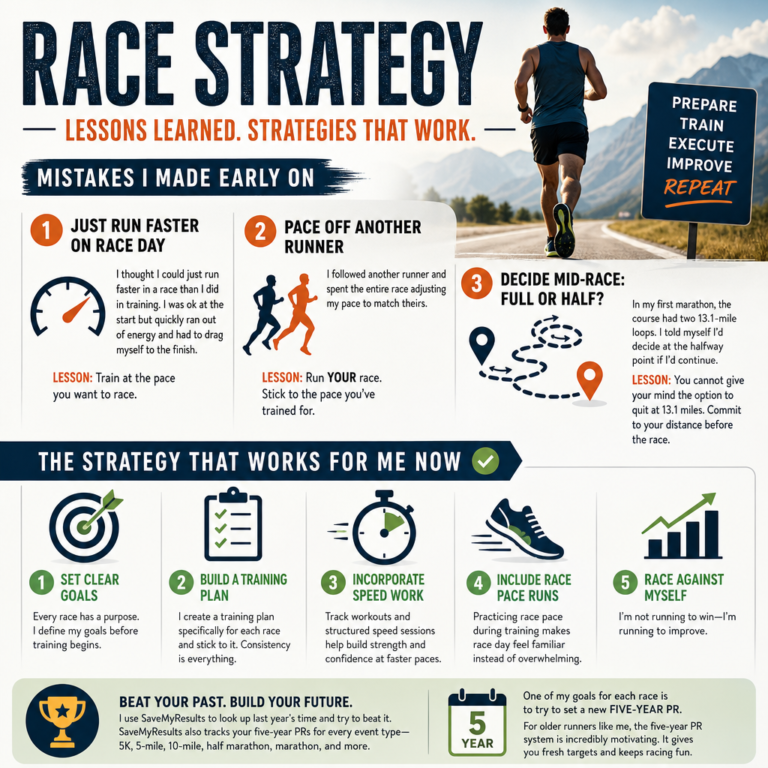
Race Strategy: What I Learned the Hard Way
Before I talk about the race strategies that work for me now, I want to share a few mistakes I made early on. These were lessons that shaped how I train and how I approach race day.
Mistake #1: “Just Run Faster on Race Day”
Early on, I assumed I could simply run faster in a race than I did during training. It worked for the first mile… and then I ran out of energy and spent the rest of the race dragging myself to the finish.
What I learned: If you want to run a certain pace on race day, you need to train at that pace. Your body has to know what that effort feels like.
Mistake #2: Pacing Off Another Runner
I used to pick someone in the race and try to match their pace. The problem? I spent the entire race adjusting my speed to theirs instead of running the pace I trained for.
What I learned: Run your race. Stick to the pace you’ve prepared for, not someone else’s.
Mistake #3: Deciding Mid‑Race Whether to Run the Full or the Half
In my first marathon attempt, the race was set up as two 13.1‑mile loops. I signed up for the full marathon but told myself, “If I feel good, I’ll keep going. If not, I’ll just stop at the half.”
This was a huge mistake. You cannot give your mind the option to quit at 13.1 miles. When I reached the halfway point, my brain chose the easy path—and I ended up running only the half marathon.
What I learned: Commit to your race distance before the race. Don’t leave the decision to your tired brain at mile 13.
The Strategy That Works for Me Now
Over the years, I’ve refined my approach. These are the strategies that consistently help me run better, stay motivated, and enjoy racing more.
1. Set Clear Goals for Every Race
Every race has a purpose—whether it’s a PR attempt, a tune‑up run, or simply enjoying the event. I define my goals before training begins.
2. Build a Training Plan Around Those Goals
I create a training plan specifically for each race and stick to it. Consistency is everything.
3. Incorporate Speed Work
Track workouts and structured speed sessions help build strength and confidence at faster paces.
4. Include Race‑Pace Training Runs
Practicing race pace during training makes race day feel familiar instead of overwhelming.
5. Race Against Myself
Like most runners, I’m not trying to win the race—I’m trying to improve. If I’m running a race I’ve done before, I use SaveMyResults to look up last year’s time and aim to beat it.
SaveMyResults also tracks your five‑year PRs for every event type—5K, 5‑mile, 10‑mile, half marathon, marathon, and more. One of my goals for each race is to try to set a new five‑year PR.
For older runners like me, this five‑year PR system is incredibly motivating. It gives you fresh targets and keeps racing fun.